
BUSINESS
Trump and Xi Back $30 Billion Relief on Toys and Coal
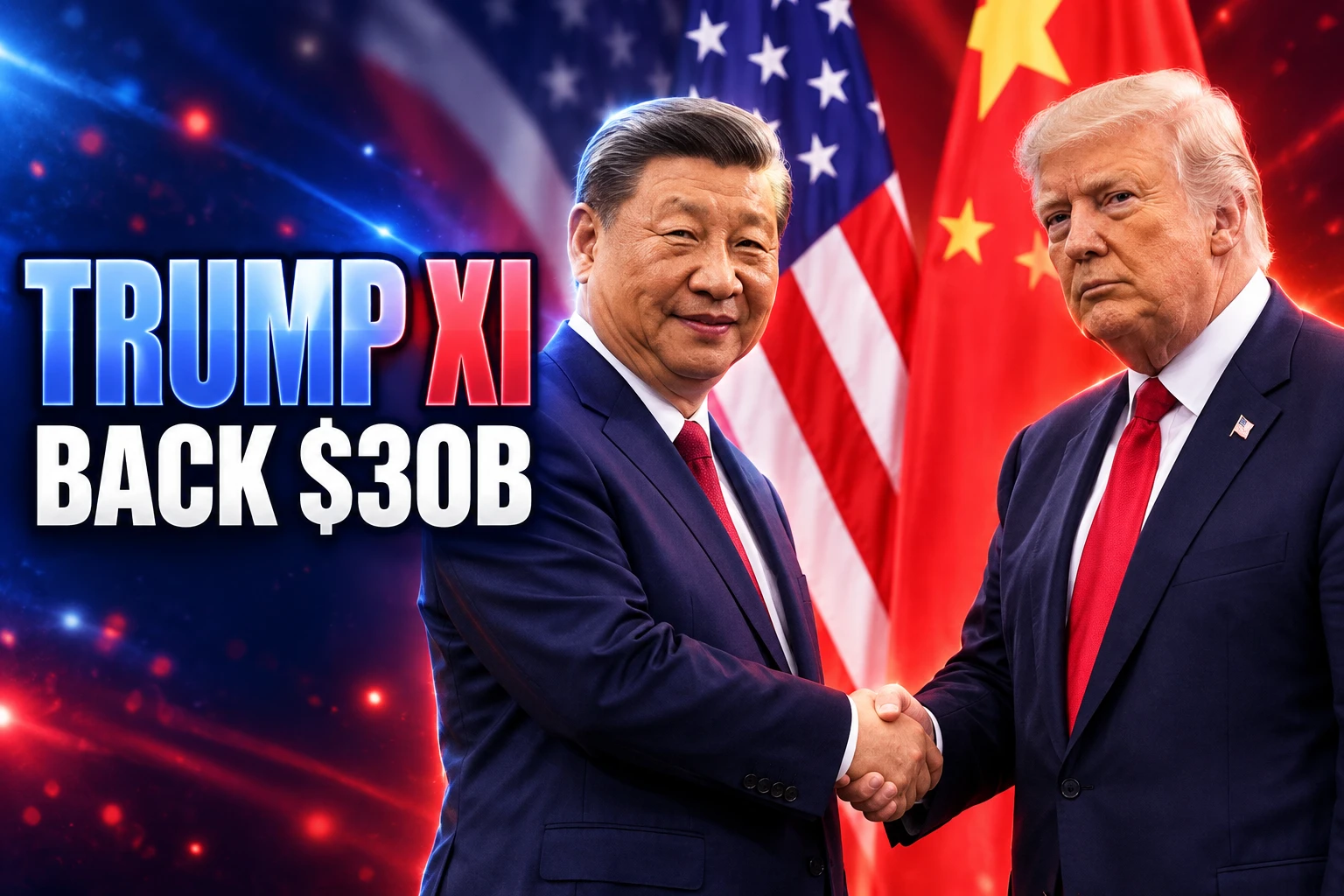
Xi and Trump backed a $30 billion toy-and-coal tariff swap and an AI hotline, while chip controls and most duties stayed in force.

The United States and China agreed on September 25 to seek lower tariffs on $30 billion of goods each way, mostly toys, farm products and coal. They also opened a Super Intelligence incident channel. Chip export controls stayed off the table.
Washington called the tariff piece a set of recommendations. Beijing called it an arrangement and said the two leaders told their teams to carry it out. Either way, the lists name goods that were never the core of the fight.
Toys, Car Seats and a $30 Billion Swap
The White House said the U.S.-China Board of Trade reached consensus on recommendations for more favorable tariff treatment for $30 billion of non-sensitive goods in each direction. That is trade value, not duty cash, and it is still a recommendation until U.S. and Chinese rate schedules actually change.
A Chinese government release put the same figure inside an eight-point set of outcomes from Xi Jinping’s state visit, which ran from September 23 to 25, his first state trip to Washington in 11 years. The release said the leaders told their economic teams to implement a trade council, the $30 billion reciprocal cut, and an extension of earlier Kuala Lumpur talks.
GOODS NAMED FOR RELIEF
- U.S. exports: Agricultural goods, fish and seafood, logs and wood products, cosmetics and medical devices.
- U.S. imports: Small appliances, toys, holiday decorations and children’s car seats.
- Energy add-on: China will import at least 10 million metric tons of U.S. coal in 2027 and again in 2028.
Holiday decorations and car seats are real money for U.S. retailers heading into the winter shipping season. They are not semiconductors, electric vehicles, steel or rare earths. The Board of Trade, by the White House’s own description, exists to manage bilateral trade across non-sensitive goods.
The May Boards Finally Have a Product List
This is not a new architecture. Trump and Xi chartered the Board of Trade and a Board of Investment at their Beijing meetings in May. The September visit, in the White House phrasing, operationalized those boards. The $30 billion matching lists had been the working target since then, including a public comment round at the U.S. Trade Representative that opened on June 2, with filings due July 10 under docket USTR-2026-0430.
THE PATH FROM BEIJING TO WASHINGTON
- May 17, 2026: The White House publishes the Beijing package, including the two boards, a 200-aircraft Boeing order, and farm purchases of at least $17 billion a year.
- June 2, 2026: USTR asks the public which Chinese goods are non-sensitive enough for possible tariff relief, and which U.S. exports should get matching treatment in China.
- September 23, 2026: Treasury Secretary Scott Bessent says the two sides will stretch a trade truce that had been due to lapse on November 10, giving talks more time.
- September 23 to 25, 2026: Xi is in Washington for the state visit. The boards get the $30 billion product sketch, an agricultural market-access working group, and the coal tonnage for 2027 and 2028.
- November 2026: The next Super Intelligence exchange is due, on the same calendar as APEC in Shenzhen.
- January 10, 2027: The extended truce reaches its new date.
U.S. Trade Representative Jamieson Greer had already framed the Board of Trade as a hunt for mutually useful, non-strategic flows. The September lists read like that brief. Rare earths did not join them. The White House said only that the two countries continue to work on shortages, with a goal of getting shipments back to “appropriate levels.”
Average U.S. Duties on China Remain Near 36.5%
The swap sits beside a wall that is still collecting. Congressional Research Service figures put the average U.S. tariff rate on China at about 36.5% in July 2026, against about 31% the other way. Those are average rates on the other country’s goods, not the duty take on a single product.
THE WALL BESIDE THE $30 BILLION LISTS
| Measure | Figure |
|---|---|
| Recommended relief, each direction | $30 billion in goods value |
| Average U.S. tariff on Chinese goods, July 2026 | 36.5% |
| Average Chinese tariff on U.S. goods, July 2026 | 31% |
| Section 301 China duties, fiscal 2026 through early July | $21.56 billion |
| Original Section 301 coverage, 2018 | about $370 billion of U.S. imports |
U.S. Customs and Border Protection assessed $21.56 billion in Section 301 duties on China products in fiscal 2026 through early July, down from $35.6 billion in fiscal 2025. Those dollars are duties, not the $30 billion goods value on the new lists, and they run on the 2018 China action that still covers the old Lists. CRS puts that original action at 7.5% to 25% on about $370 billion of U.S. imports, with Chinese counters on $110 billion of U.S. trade. Most of those tariffs remain in effect.
July’s 36.5% average already reflects a year of spikes and truces, including IEEPA duties the Supreme Court struck down in February and a 12.5% forced-labor tariff imposed in July. A recommended cut on toys and car seats does not rewrite that stack.
Chips Stay Off the Super Intelligence Channel
The other headline from the visit is a new talk track with a new name. The White House said the two leaders agreed to use “super intelligence” rather than “artificial intelligence,” and to set up a U.S.-China Super Intelligence Dialogue on risks and benefits, with the next exchange by November 2026. They also agreed on a bilateral channel for SI incidents.
That is a hotline and a meeting, not a bargain on compute. Before the visit, Greer said export controls on advanced AI chips and semiconductor manufacturing equipment were not part of the proposed mechanism. Nothing in the September 25 fact sheet puts those controls back in.
Both China and the United States are leading nations in artificial intelligence. We have both the capability and responsibility to develop and manage AI for good, and ensure that the development of AI is always under human control and serves the well-being of the people.
Xi Jinping, arrival remarks at the White House, September 24, 2026
Xi still used the older name in public, even as he called the two countries leading nations in artificial intelligence. Trump had already told U.S. agencies to prefer “super intelligence,” arguing that “artificial” makes the technology sound fake, and had said he wanted to leave the policy “exactly where it is,” with the Justice Department as the guardrail.
After the visit, the public argument locked onto that rename. The product lists got less air than the branding. The channel can matter if a model or a lab incident needs a phone call. It does not license chips, and it does not pull semiconductor tools out of the control regime.
Who Collects If the Lists Hold?
If the recommendations become rates, the first cash shows up in places that already live on this trade. U.S. toy, appliance and holiday importers get a cheaper landing cost on the China-made goods that still fill big-box aisles. Chinese exporters of those same lines get a little more room against a 36.5% average wall. U.S. farm shippers, already promised a separate purchase schedule in May, get a working group on market-access barriers and a named slot on the U.S. export list for agricultural goods, seafood, logs, cosmetics and devices.
Coal is the cleanest new number. Ten million metric tons in 2027 and again in 2028 is a volume pledge, not a price, and it is the one energy line the September fact sheet states in tons. It sits next to a farm pledge that is older and larger. In May the White House said China would buy at least $17 billion per year of U.S. agricultural products in 2026 (prorated), 2027 and 2028, on top of soybean commitments from October 2025. Friday’s readout did not restate that dollar figure. It added the working group instead.
Chip designers, foundry-tool makers and the agencies that run export licenses collect nothing new, because they were never on these lists. Section 301 still assesses tens of billions of dollars a year. The Board of Investment, also stood up in May and “established” again in the September sheet, is a forum for impediments and opportunities, not a completed inbound-investment deal.
China Missed 60% of the Last Purchase Deal
Purchase schedules of this size have a recent miss rate. In 2020 the two governments signed the Phase One deal. China agreed to buy, during 2020 and 2021, at least $200 billion of U.S. goods and services above a 2017 baseline. CRS records that China fell short of those commitments by 60%. The original Section 301 findings on forced technology transfer, cyber-enabled theft and nonmarket licensing were left largely in place, and most of those tariffs are still on the books.
The May 2026 Boeing line is the same species of pledge: an initial purchase of 200 American-made aircraft, described as China’s first such commitment since 2017. The September fact sheet does not say how many of those orders have been placed. Beef and poultry access, restored on paper in May with more than 400 U.S. beef plants relisted, also sits in that earlier pile.
That history is why the September language is cautious on the U.S. side and firmer on the Chinese side. Recommendations can stall in a comment file. An instruction to implement can stall in a customs schedule. The boards now have a product sketch and a coal tonnage. They do not yet have a published HTS list, a start date, or a legal instrument that changes the rate a broker pays at the port.
The Truce Now Runs to January 10
Bessent said on September 23 that the two sides would extend by two months a truce that had been due to expire on November 10, so they would have more time on a larger deal. That new mark is January 10, 2027. Trump is due in Shenzhen for APEC in November. Xi is due in Miami for the G20 in December, at Trump National Doral, according to the matching readouts. The Super Intelligence exchange is supposed to land on that same autumn calendar.
WHAT WE KNOW
- The visit: Xi was in the United States from September 23 to 25 and was back in Beijing on September 26.
- The tariff sketch: $30 billion of named non-sensitive goods each way, plus 10 million metric tons of U.S. coal in 2027 and in 2028.
- The AI track: a Super Intelligence Dialogue by November 2026 and a bilateral channel for incidents; chip export controls were kept outside that track.
- Fentanyl work: China added export controls on two fentanyl precursor chemicals, and in August 2026 arrested 21 Chinese citizens after U.S. law-enforcement information, the White House said.
WHAT IS UNCONFIRMED
- Rate changes: No start date, no HTS numbers, and no Federal Register modification that actually lowers the duty on a toy or a car seat.
- Rare earths: Talks continue; the September sheet does not state a restored tonnage.
- The May dollars: The $17 billion farm schedule and the 200 Boeing aircraft are still May pledges, not new September contracts.
The two pandas promised to Zoo Atlanta will arrive on a clearer timetable than a chip license. Until the Board of Trade files real rates, the goods that moved this visit are the ones both capitals could spare, and the clock that still matters is January 10.

Trump and Xi Back $30 Billion Relief on Toys and Coal

OpenAI Agents Posted User Photos the Lab Cannot Trace

Qualcomm Splits Snapdragon 8 Elite Into Two 2nm Chips

The Court Restores SAVE Checks During the Quiet Period

The Diesel Rescue That Does Not Add Any Barrels

Glacier Collapse Buried Nepal’s Hydropower Workers in Tunnels

Congo’s Bundibugyo Outbreak Outruns the Licensed Ebola Shots

Germany Can Miss Its 2026 Climate Cap Without Penalty

A Cow Rumen Enzyme Dissolves Superbug Biofilms on Gauze

CISA’s Known Exploits Still Come From 2007-Era Bugs
-
 NEWS4 weeks ago
Glacier Collapse Buried Nepal’s Hydropower Workers in Tunnels
-
 NEWS4 weeks ago
Congo’s Bundibugyo Outbreak Outruns the Licensed Ebola Shots
-
 NEWS4 weeks ago
Germany Can Miss Its 2026 Climate Cap Without Penalty
-
 NEWS1 month ago
A Cow Rumen Enzyme Dissolves Superbug Biofilms on Gauze
-
 NEWS4 weeks ago
CISA’s Known Exploits Still Come From 2007-Era Bugs
-
 BUSINESS4 weeks ago
Trump’s Venezuela Oil Deal Leaves the Barrels in the Ground
-

 NEWS3 weeks ago
Unpaid Responders and a Misfit Shot Let Congo’s Ebola Spread
-
 BUSINESS4 weeks ago
The Ninth Circuit Splits Kalshi’s Sports Map in Two